Digital Product Passport (DPP) with RFID: How It Works, Benefits, and Implementation Tips

Subscribe to our newsletter!Stay up to date, subscribe to our newsletter!
SubscribeChoosing the right release liner for pressure-sensitive adhesive labels depends on application method, liner material, release system, thickness, and stability. The right balance ensures efficient converting, smooth dispensing, and reliable performance. Explore the details below to learn how to choose correctly.


Pressure-sensitive labeling has evolved into a highly engineered process where every component matters. Among these components, the release liner plays an important yet often underestimated role, influencing converting performance, dispensing reliability, and end-use success across industries and applications.
Many labeling challenges, such as label breakage, poor dispensing, or inconsistent adhesion, can be traced back to liner mismatch. Without understanding how to choose a release liner correctly, brands risk inefficiencies, downtime, and higher costs, especially when balancing speed, sustainability, and compatibility with modern equipment.
This article shows how to choose a release liner effectively. By exploring materials and real-world considerations, you will gain clarity to optimize PSA labels. Continue reading to discover how informed liner choices drive performance and long-term value.
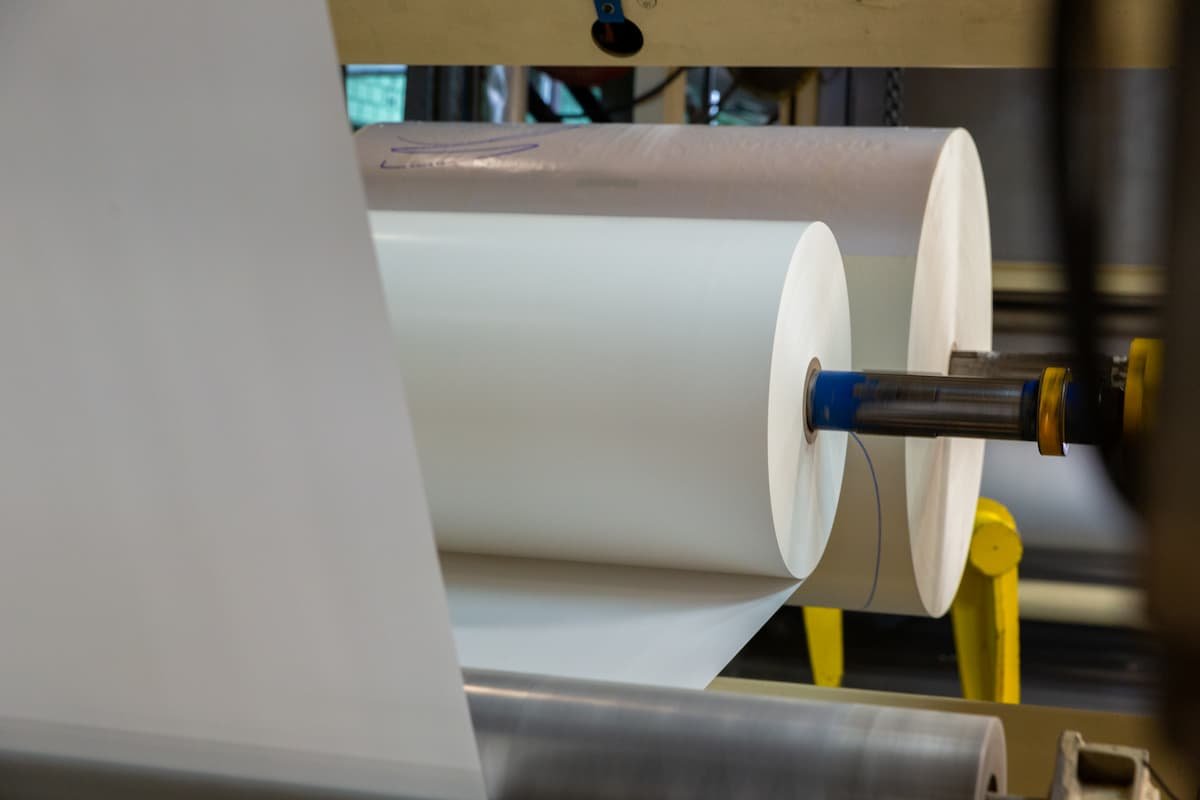
A release liner is a paper or plastic-based backing designed to prevent the adhesive on a pressure-sensitive label from sticking prematurely. It protects the adhesive during printing, converting, storage, and transport, then allows clean, controlled release when the label is applied.
In label constructions, the liner serves as a carrier for the adhesive and facestock until application. Its release surface, often silicone-coated, ensures labels detach smoothly with consistent force, reducing machine stops and defects.
Depending on substrate and coating, release liners can balance stiffness, stability, and release force to optimize performance in various PSA labeling environments, from high-speed automated lines to manual application.
Release liners are generally divided into film liners and paper liners, each offering distinct mechanical, dimensional, and functional characteristics.
The right choice depends on application speed, environmental conditions, converting constraints, and performance expectations.
Film liners are plastic-based materials known for their consistent thickness and stable behavior during application. Because they are not affected by humidity like paper, they perform well in high-speed and high-precision labeling operations.
They are commonly used when labels are thin, designs are complex, or application accuracy is important. Film liners also help reduce breaks and misalignment during dispensing.
PET liners are the most stable option among film liners. They stretch very little and keep their shape even at high speeds, which helps labels release smoothly and land in the correct position.
They are often chosen for applications where consistency matters more than cost, especially in automated lines.
When to use: high-speed dispensing, thin labels, precise placement, specialty PSA labels.
PE liners are more flexible than PET and offer good resistance to moisture. While they are not as dimensionally stable, their flexibility can be useful in certain applications.
They work best when some adaptability is needed, and extreme precision is not the main concern.
When to use: curved surfaces, moderate-speed lines, specific application needs.
BOPP liners offer a balance between performance and cost. They are stiffer than PE and provide reliable release in controlled environments.
They are widely used in consumer goods labeling where production conditions are stable and cost efficiency is important.
When to use: FMCG labels, dry environments, medium-speed applications.
Paper liners remain the most used option in release liners for pressure-sensitive adhesive labels due to their stiffness, availability, and cost-effectiveness. Their performance depends on how the paper is processed and coated.
Paper liners work well in many standard labeling operations and are compatible with a wide range of adhesives and equipment.
Glassine is one of the most widely used release liners. It has a smooth surface and good stiffness, allowing labels to release consistently during application.
Although sensitive to humidity, glassine performs very well in controlled environments and high-volume production.
When to use: standard PSA labels, high-volume runs, controlled conditions.
CCK liners are paper liners with a coated surface that improves smoothness and strength. They are thicker and more rigid than glassine, which helps during converting and dispensing.
They are often used when labels are larger or need extra support.
When to use: larger labels, demanding converting processes, high-speed lines.
FBK liners are made from bleached pulp, offering a clean and uniform appearance. They are commonly used in industries with strict quality and hygiene standards.
These liners provide reliable performance when paired with the right release coating.
When to use: food, pharmaceutical, and medical labeling.
Layflat liners are designed to stay flat during printing and converting. This reduces curling and improves label alignment.
They help increase efficiency by minimizing waste and machine adjustments.
When to use: wide web printing, large labels, applications requiring good registration.
MF liners are a cost-effective paper option with moderate smoothness and stiffness. They are suitable for applications that do not require high precision.
They offer reliable performance when production conditions are stable.
When to use: basic PSA labels, cost-sensitive projects.
PCK liners combine paper with a plastic coating to improve resistance to moisture. This makes them more stable in humid or cold environments.
They maintain stiffness while reducing the risk of liner deformation.
When to use: refrigerated products, humid environments, cold-chain labeling.
SCK liners are compressed paper liners that offer a smoother surface and higher density than MF liners. They provide a good balance between performance and cost.
They are widely used in industrial and logistics labeling.
When to use: logistics labels, industrial applications, consistent mid-range performance.
Glassine and PET are the two most widely used release liner types in pressure-sensitive adhesive labels.
Both are well established in the market and support a broad range of applications, but they perform differently depending on converting conditions, application speed, and environmental factors.
| Aspect | Glassine liner | PET liner |
| Material type | Paper-based | Film-based (polyester) |
| Market usage | One of the most widely used liners worldwide | One of the most commonly used film liners |
| Dimensional stability | Moderate, influenced by humidity | High and consistent |
| Behavior at high speeds | Suitable for standard speeds | Performs very well at high speeds |
| Thickness consistency | Good, with natural paper variation | Excellent and highly uniform |
| Environmental sensitivity | Sensitive to humidity and temperature changes | Resistant to moisture and environmental variation |
| Cost position | More cost-efficient | Higher initial cost |
| Typical applications | Standard PSA labels, controlled environments | Automated lines, precision applications |
| Sustainability considerations | Paper-based, widely recycled where systems exist | Enables downgauging and material reduction |
Choosing the correct release liner for pressure-sensitive adhesive labels is less about selecting a material by name and more about understanding how the label will be produced and applied.
Following the right steps helps avoid common issues such as poor dispensing, material waste, and inconsistent performance.
Instead of starting with glassine, PET, or any other liner type, the best practice is to evaluate the application first and then narrow down the liner characteristics that truly matter. The steps below help guide that decision in a practical and reliable way.
The first step is to define how the label will be applied. The dispensing method directly affects the level of stability and release control required from the liner.
It´s important consider some key points:
Highspeed automated lines typically demand more stable liners, while manual applications allow for greater flexibility.
Next, it is important to understand how the label will be printed and converted. The liner plays a role throughout processes such as die-cutting, slitting, rewinding, and matrix removal.
Factors like the printing technology used, press speed, the complexity of the die-cut shape, web width, tension, and handling influence liner performance during conversion.
When liner properties are aligned with these converting constraints, production becomes more efficient and material waste is significantly reduced.
The release system controls how easily the label separates from the liner. It must be compatible with both the adhesive and the application conditions.
A release that is too strong can cause dispensing issues, while a release that is too light may lead to premature label release.
The goal is a controlled, consistent release that supports smooth application across the entire production run.
Liner thickness affects stiffness, handling, and overall performance. Thicker liners provide easier handling and stability, while thinner liners help reduce material usage and waste.
Dimensional stability becomes especially important for highspeed lines, thin labels, or complex designs. The right balance between caliper and stability ensures reliable performance without unnecessary material use.
Even with careful planning, trials are the most reliable way to validate liner performance. Real-world testing allows evaluation under actual converting and application conditions, where variables such as speed, tension, and equipment come into play.
The trials help confirm release behavior, dispensing consistency, and overall process efficiency before full-scale production.
This step reduces risk, prevents costly adjustments later on, and ensures the selected liner delivers the expected performance in real applications.
Sustainability is increasingly relevant in liner selection, but it should not compromise performance. Choosing the right liner in terms of material, thickness, and release system helps reduce waste, avoid overengineering, and improve efficiency during converting and dispensing.
Liners with better dimensional stability and consistent release can prevent misfeeds, label breaks, and downtime, which are common sources of material waste.
In addition, advances such as downgauged liners, optimized paper structures, and solutions aligned with recycling streams support environmental goals while maintaining the performance required for demanding applications.
Choosing the right release liner can be complex, especially when performance, converting efficiency, application requirements, and sustainability goals all need to align. This is where Beontag’s expertise makes a difference.
With a broad portfolio of paper and film liners, multiple release systems, and deep technical know-how, Beontag works closely with customers to understand each application in detail. From selecting the most suitable liner type to fine-tuning caliper, stability, and release behavior, the focus is always on delivering consistent performance in real conditions.
In addition, Beontag supports customers through technical guidance and trials, helping to validate liner choices before full-scale production. This collaborative approach reduces risk, improves efficiency, and ensures the selected solution performs as expected, on the press, on the line, and in the field.